
The same coffee, day and night: coffee is multisensory
The colour of the cup, its shape, the music: all of it changes what we taste. What we took away from a talk on the multisensory side of coffee.

A talk that changed the way we look at a cup
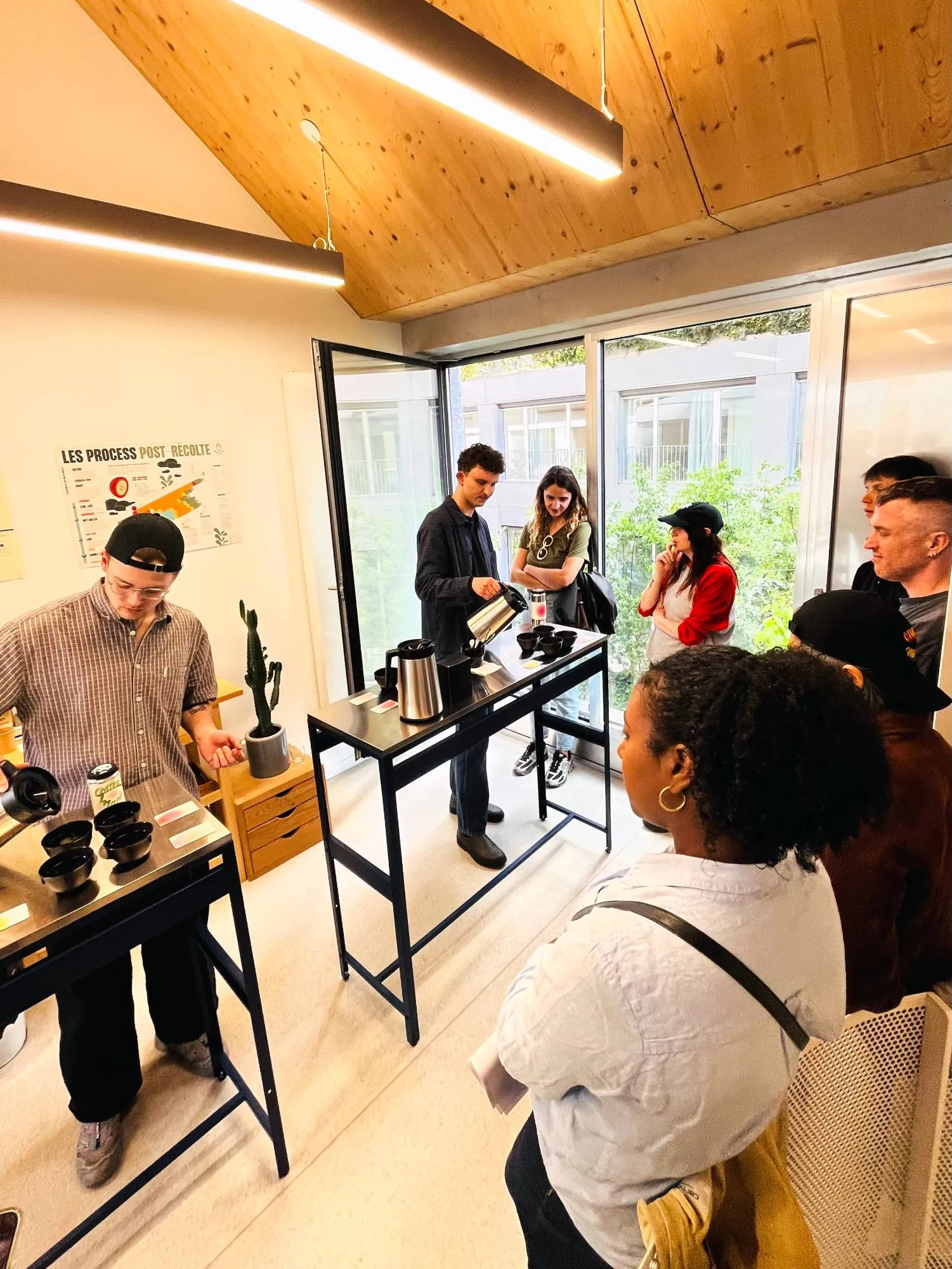
We recently sat in on a fascinating talk by Noa Berger, a sociologist of coffee, at the Le Mark de Café workshops in Paris. Her subject: the multisensory nature of coffee.
The starting point sounds simple, almost obvious: we do not taste with the tongue alone. And yet it quickly unsettles the way we talk about a coffee.
The colour of a cup, the shape of the vessel, the light in the room, the surrounding noise or the music playing can all change the way we perceive one and the same coffee. A coffee that comes across as bright and tangy in one setting may seem rounder, sweeter — or, on the contrary, more bitter — in another.
Without a single coffee leaf having changed. Without a single brewing variable having been touched.
It is a little like day and night: the landscape stays the same, but the light changes everything.
Tasting is assembling
What we casually call “taste” is in fact something we build. The tongue picks up basic sensations — sweet, sour, bitter, salty, umami — but flavour as we live it comes from a far wider combination: aromas, texture, temperature, appearance, expectations, memories and context.
Researchers speak of crossmodal interactions: our brain is constantly tying together information coming from several senses. Sight sets up an expectation. Smell steers perception. Touch — the curve of a cup, the heat of the liquid, the texture in the mouth — then confirms or disturbs what we were expecting. Sound, too, plays its part in that inner staging.
In other words, tasting a coffee is not reading a tasting note. It is living an encounter between a product, a context and a person.
Colour: a light that changes the cup
Among the most striking examples is the colour of the vessel. It obviously does not alter the chemical make-up of the coffee, but it shapes our expectations — and our expectations shape the tasting.
Work carried out on specialty coffee has shown that the colour of the cup can affect consumers’ expectations as well as their tasting experience. Other research suggests that some colour-to-taste associations are especially widespread: pink and red often evoke sweetness, yellow and green acidity, while brown, black or purple are more readily associated with bitterness.
This does not mean that a pink cup mechanically makes a coffee sweet. But it can steer attention, raise an expectation, change the way we read a sensation.
The coffee stays the same. Our reading of it shifts.
Shape: the vessel is part of the recipe
The shape of the cup plays just as interesting a role. A narrow cup does not direct the aroma the way a wide one does. It does not hold the nose at the same distance from the liquid, does not concentrate the volatile aromas in the same way, and does not invite the same gesture.
Studies on coffee vessels have shown that shape can influence the perception of aroma, sweetness and acidity, including among people well used to specialty coffee.
Here again, the point is not that a cup “improves” a coffee in absolute terms. But it can bring out certain aspects of the experience.
It is a very useful idea for anyone interested in coffee: service is not a decorative detail. It is part of the recipe.

Music: day and night in your ears
This is probably the most surprising part: music too can influence what we perceive in a cup.
Research on sound-to-taste correspondences suggests that high, soft or fast sounds are often associated with sweetness or acidity, while low, more powerful or more dissonant sounds can be associated with bitterness or intensity. Studies on coffee have explored the effect of different soundscapes and pieces of music on the dynamic perception of flavour and on the emotions a tasting evokes.
In practice: the same coffee, heard alongside bright, delicate music and then in a darker or more percussive soundscape, may not tell quite the same story.
Acidity can seem sharper. Bitterness can feel more present. Sweetness can fade or, on the contrary, come forward.
That does not mean music transforms the coffee in any chemical sense. It transforms our attention, our mood, our expectations and the way our brain assembles the experience.
Why we find this fascinating
What we like about this approach is that it makes tasting more alive — and less intimidating.
We sometimes tend to believe there is one “right” reading of a coffee: exact notes, descriptors to recite, a correct interpretation. Multisensory perception is a reminder that taste is, instead, a situated experience.
It depends on the coffee, of course. But also on the moment, the place, the cup, the light, the sound and the person doing the tasting.
This is not a loss of rigour. It is another kind of precision: understanding that perception is a system, not a straight line.
What it inspires in us at Yunma
A Yunnan coffee is not a fixed list of notes. It is an origin, a terroir, a producer’s work, a processing method, a roaster, a brew — and then an encounter with whoever drinks it.
The same cup can be fruity and bright in the morning, more enveloping at the end of the day. It can seem more floral in soft light, more direct in a dark cup, more delicate with calm music.
That is exactly what interests us at Yunma: not reducing coffee to a product to be consumed, but treating it as a complete sensory experience.
An experience that begins before the first sip — sometimes even before the water touches the coffee.
A small experiment to try at home
If you feel like it, run a very simple test:
- Brew two strictly identical cups of the same coffee.
- Taste the first in silence, paying attention to the aroma, the attack, the mid-palate and the finish.
- Taste the second while listening to music you love.
- Do it again with very different music.
- Note what seems to change: acidity, sweetness, bitterness, body, length.
There is no right answer. The point is not to find the “truth” of the coffee, but to watch how your own perception moves.
Because in the end, that may be the finest definition of taste: a conversation between the world and us.
Read more
- How to brew a great drip bag
- Catimor, Yellow Bourbon, Pacamara: three Yunnan varieties
- Our Yunnan coffees
The work and places mentioned
- Noa Berger — Coffee in Translation (Substack): her writing on the history, culture and circulations of coffee.
- Noa Berger, “Coffee and Music: Crisis and Creation” — Standart: an article on the ties between coffee and music.
- Le Mark de Café: workshops, training and events around coffee in Paris.
- Coffee and Health — “Coffee and the senses: Multi-sensory interactions”: an accessible overview of how appearance, context and the senses shape the coffee experience.
- Carvalho & Spence, “Cup colour influences consumers’ expectations and experience on tasting specialty coffee”: a study on the effect of cup colour.
- Spence et al., “Explaining Crossmodal Correspondences Between Colours and Tastes”: a review of colour-to-taste associations.
- “The shape of the cup influences aroma, taste, and hedonic judgements”: a study on the influence of cup shape.
- “Impact of music on the dynamic perception of coffee and evoked emotions”: research on the effect of music on coffee perception.
Sources
- Coffee and Health, Coffee and the senses: Multi-sensory interactions
- Carvalho, F. M. & Spence, C., Cup colour influences consumers’ expectations and experience on tasting specialty coffee, Food Quality and Preference
- Spence, C. et al., Explaining Crossmodal Correspondences Between Colours and Tastes, i-Perception
- The shape of the cup influences aroma, taste, and hedonic judgements
- Impact of music on the dynamic perception of coffee and evoked emotions, Food Research International
- Cross-modal perception between soundscape and taste contributes to liking of coffee, University of Helsinki
- Noa Berger, Coffee in Translation
- Noa Berger, Coffee and Music: Crisis and Creation, Standart
- Le Mark de Café
