
The coffee variety atlas: 610,000 years in three dimensions
An interactive atlas of the 65 coffee varieties and species: their parentage, their dates, their arrival in Yunnan — with sources. In French, English and Chinese.
When you read “Catimor” on a bag of coffee, the word says nothing on its own. It starts to mean something once you know where it comes from: a Portuguese cross made in 1959 between a Brazilian Caturra and the Timor Hybrid, which itself appeared on its own, on an Indonesian island, from a cross between an Arabica and a Robusta. That chain is what we wanted to make visible.
The coffee variety atlas is online. It covers sixty-five varieties, species and populations of coffee tree, from the birth of Arabica — 350,000 to 610,000 years ago, in Ethiopia — to selections still in trial today. Each carries its date, its place, its parents, its descendants and its sources. It can be read in French, English and Chinese.
A tree, not a list
Variety catalogues exist, and they are excellent: World Coffee Research’s is the reference. But an alphabetical list does not show what matters most — who descends from whom, and when.
So the atlas is a tree, set inside a sphere you can turn. The vertical axis is time, on a compressed scale: the early millennia are squeezed together, the last century stretched out, without which everything since 1900 would fit inside the thickness of a line. Varieties are ranged by lineage, one colour per family — the Ethiopian landraces, the two great branches that came out of Yemen, Typica and Bourbon, the introgressed varieties that took on Robusta genes, the Yunnan selections. The lines between them say what kind of link it is: descent, mutation, hybridisation.
From 1892, the central axis becomes the Yunnan timeline. That is the moment when the two stories, the species’ and the province’s, begin to walk together.
What it holds on Yunnan
Yunnan supplies 98% of China’s coffee, and its genetic history comes in three stages.
Typica and Bourbon cross the Burmese border in 1914, at Nongxianshan, near Ruili — twenty-two years after the first coffee trees planted by a French missionary at Zhukula. From 1988, a programme run with the World Bank and the UNDP, then with Nestlé, converts almost the whole crop to Catimor: a single line, CIFC 7963, carrying Robusta genes through the Timor Hybrid. And since the 2010s a new wave has been replanting Geisha at altitude.
The atlas also gives the province’s seven growing regions, their altitudes and their lots — including the Gems of Yunnan 2026 top fifteen, where thirteen of the fifteen best coffees are Geisha, but where a Catimor from Baoshan scores 88.53.
Day and night
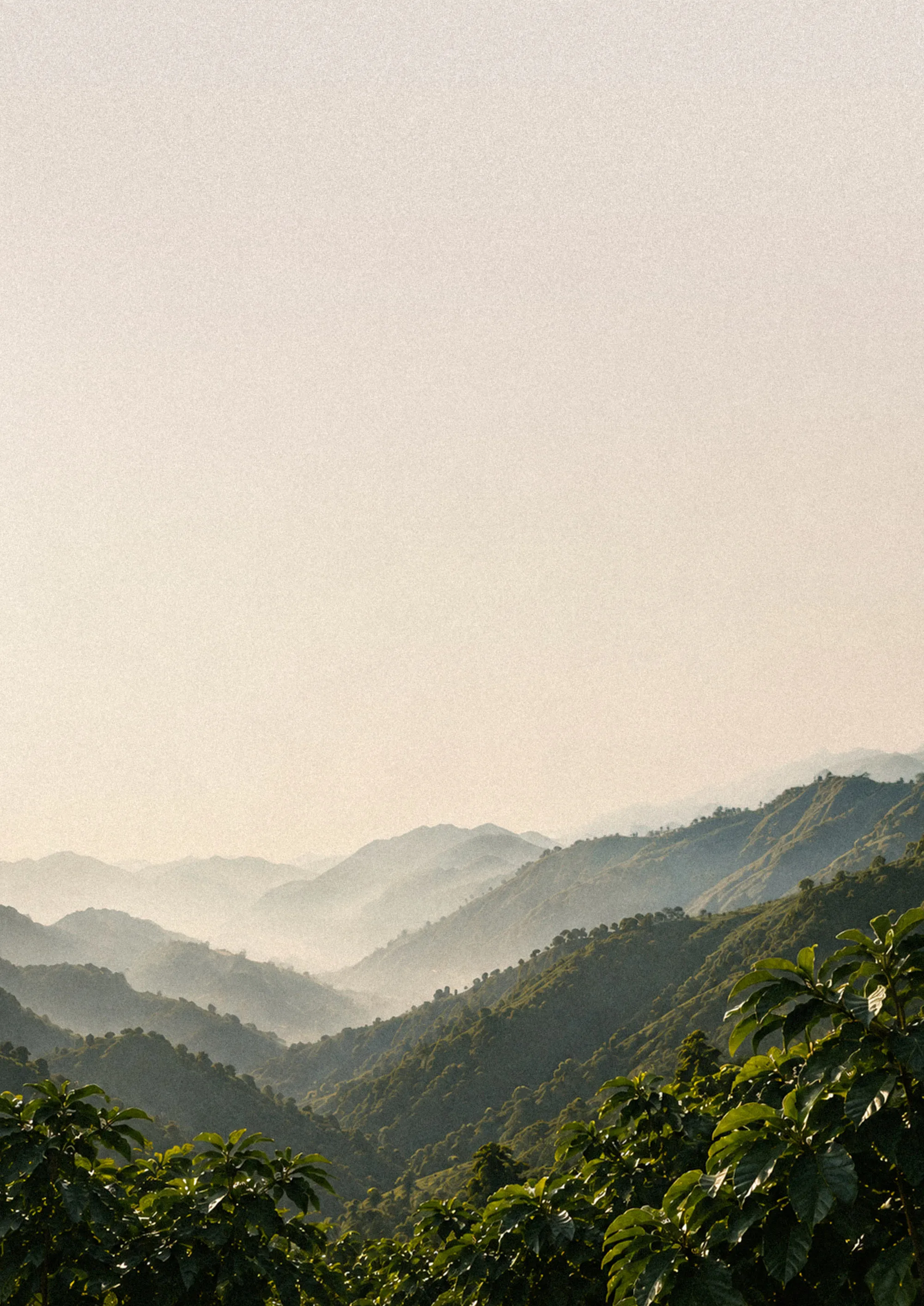
One more thing, which was not planned at the outset. The atlas arrives at whatever time it is where you are: open it at eleven at night and it is dark over the mountains, the ink turns pale and the stars come out. Time runs twelve times faster than the clock there, so a long visit sees the light turn. The relief is not invented: it is south-west Yunnan, from 97.8° to 102.6° east, surveyed and then smoothed.
Why we made it
Because we buy direct, and buying direct means knowing what you are buying. The varieties we work with — Catimor, Yellow Bourbon, Pacamara, Geisha — each have a history, and that history is as present in the cup as altitude or processing.
Dates and lineages come from the World Coffee Research catalogue, from the genomic study published in Nature Genetics in 2024 and from specialist sources, all cited. Where a date is disputed — Zhukula is 1892, 1902 or 1904 depending on the source — the atlas says so rather than choosing.
In early 2027 we head back to Yunnan to meet new producers. What we bring back will join the atlas, farm by farm.
